We've had a busy week in the studio now that the weather is hot - Katherine and I did two raku firings over the last two days, with mostly successful results. For the first one, we used long dry grass for the reduction - you can see the pattern it left on my white crackle pot here:
We also used a couple of green copper-based glazes which gave some great 'copper penny' colour flashings. For the second firing we used dry pine needles which put out a lot of dense smoke and turned the unglazed part of the pots a deep black:
I've finished two large terracotta amphoras now and have started on another two - these ones have a rounded shape, including the rims and handles:
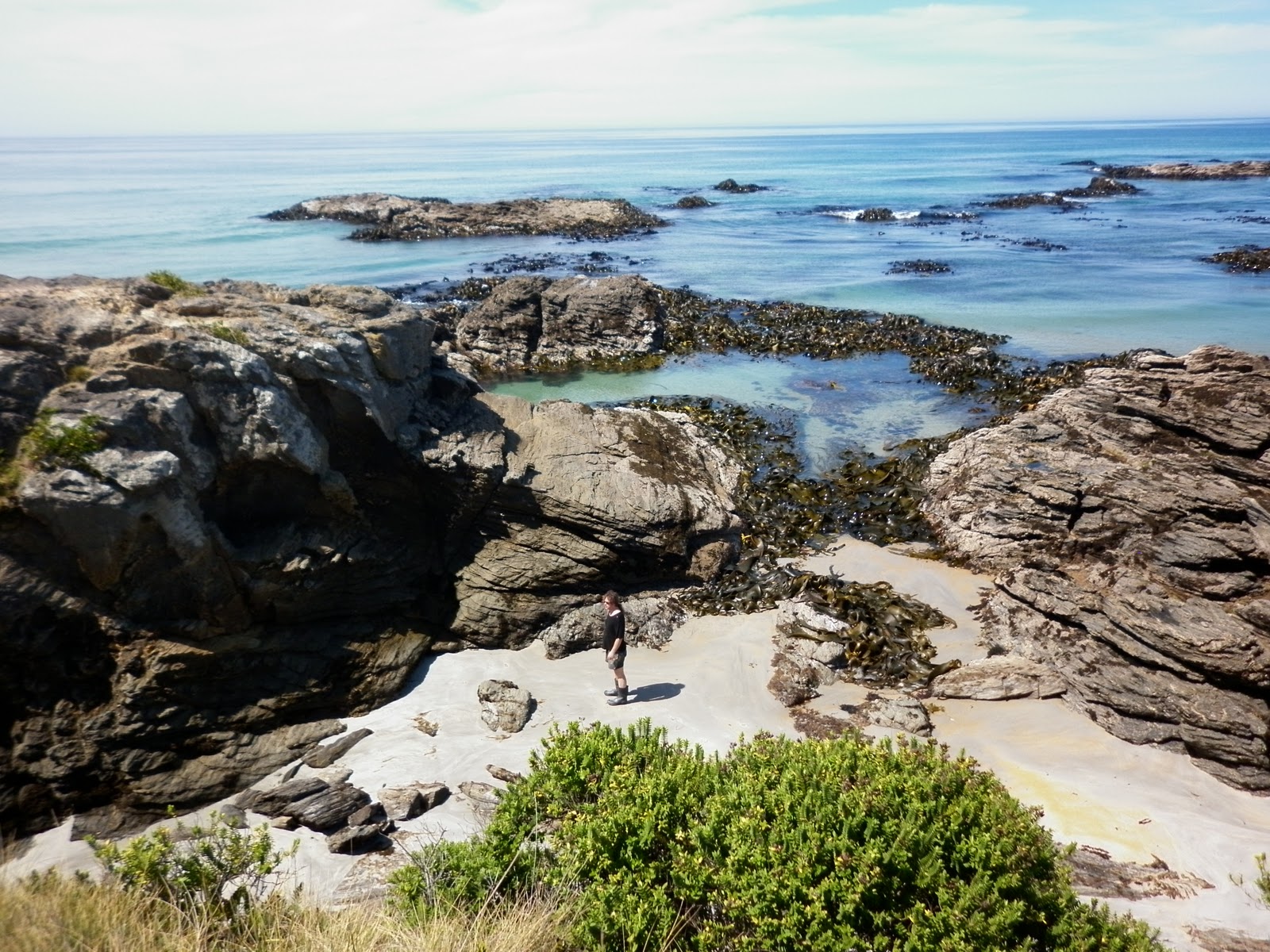
One of the great things about working from home at Brighton is taking your lunch break at the beach! Here I am yesterday checking out some of the rock pools and natural swimming holes on the coastline, just a couple of minutes drive away:
More photos on our Flickr photo stream, here.
Showing posts with label terracotta. Show all posts
Thursday, November 11, 2010
Wednesday, October 27, 2010
Bees, Birds...and Big Pots
We had to stop potting for the afternoon yesterday when a bee swarm showed up out of nowhere. According to this fascinating article in Wikipedia, 'the bees are usually not aggressive at this stage of their life cycle' but I wouldn't want to test it - they sound intimidating enough. It's incredible the way such tiny animals can communicate with each other so effectively that they behave like a single organism.
The swarm buzzed around the house for a while looking for a way in (fortunately we remembered to shut ALL the doors and windows) and then settled in a branch of a tree above the woodshed. They stuck around there in a big humming ball until lunchtime today, when they swarmed off again in search of their new home... but where did they go?!?
Katherine also took a photo of a white-faced heron this morning, trying to blend in with the buttercups:
We get a lot of interesting birds out here in Ocean View, from introduced English species like swallows and magpies, to natives like bellbirds, tui, Paradise Ducks and even a couple of kahu, or harrier hawks, which have been circling each other high in the air lately, doing their courtship dance. An amazing thing to watch.
To get back to the pottery theme - here's a photo of a couple of big planters I've been working on. They are made with local terracotta, in a combination of coiling and throwing techniques:
The swarm buzzed around the house for a while looking for a way in (fortunately we remembered to shut ALL the doors and windows) and then settled in a branch of a tree above the woodshed. They stuck around there in a big humming ball until lunchtime today, when they swarmed off again in search of their new home... but where did they go?!?
Katherine also took a photo of a white-faced heron this morning, trying to blend in with the buttercups:
![]() |
To get back to the pottery theme - here's a photo of a couple of big planters I've been working on. They are made with local terracotta, in a combination of coiling and throwing techniques:
Saturday, August 28, 2010
From the Ground Up
For the last few months, I've been working on finding and preparing my own clay bodies. Like most things, the price of clay has skyrocketed in the last few years, and knowing that I can throw as much clay as I want without worrying about the price has really freed up my creativity.
Dunedin with its ancient volcanic rock is a good source of plastic, terracotta clays - from weathered basalts up North East Valley to schists around Brighton. Each clay has its own personality, and using local clay gives a pot its own unique character, grounded in space and time. It can be refined, but is also really nice used raw with all its impurities.
Most how-to pottery books give the basics on finding clay. Road cuttings and creek beds are good places to look, sometimes local history and place names can hold clues as to where to start digging. Here I am prospecting in North East Valley, where I found a very nice terracotta:
And here I am digging behind my studio in Brighton, where I found another terracotta, also very good on its own.
Once dug, the clay needs to be tested for plasticity, shrinkage and firing range. A little minigama kiln is perfect for test-firing small amounts - and you can get some sauce dishes and beakers out of it, too. The local clay I've found so far seems to be good around Cone 02. Here's some terracotta bowls I fired out of the first batch of NEV terracotta, with my minigama:
| Minigama kiln and test pots |
Processing the clay takes around two or three days. I break it up and dry it in the sun, crush it, sieve it, then put it in buckets covered with water and blunge it with an electric drill. I then pour it into a clay bath to settle, dry it on plaster bats, and finally put it through a pug mill and into bags. (We're working on putting together a You Tube video which should show the whole thing). It's a messy business but not too hard once you get into a system. Not all that much different than recycling clay.
The next step for me will be to develop some Cone 02 glazes for my clay body, but in the meantime, the terracotta also looks gorgeous on its own.
It's perfect for flower pots and planters, which look great on a windowsill but will only get more beautiful the more they are left outside:
| Rustic flowerpots |
I also used it to make some amphorae and West African style pots, which I fired to Cone 02 (1120 Celsius) on Thursday:
:
| Opening the gas kiln, after work at NZ Post |
| Some African-style pots in front of the stack, sitting on the planters, amphorae in the background. |
| North East Valley terracotta amphora |
| Close up showing the coarse natural texture of the clay |
Subscribe to:
Posts (Atom)